

Proof That It’s Pre-Code
- One man describes Jean Harlow‘s movie star character Lola Burns as “a boon to re-population in a world thinned by war and famine!” That’s a great line.
- Jean Harlow’s maid, a black woman named Loretta (Louise Beavers) gets paid in undergarments, because she goes through a lot of them. Harlow even comments, “Your day off is sure brutal on your lingerie.” Needless to say, implying that a black character is going around and having a ton of sex is not something you catch a lot in movies of this era.

About ten minutes of this film are about Lola Burns starring in Red Dust. I’ll get into that more below, but, yeah, Lola is instructed to strip down and get ready for the rain barrel.
- When Burns is ordered down to the movie set, she’s told to wear a white dress without the brassiere. Oh, Hollywood, and their belief that the male audience will be enraptured by only the basest of titillation!
- … she doesn’t wear the bra, in case you were wondering.
- There’s lots of double entendres, with things like Burns’ dad discussing his horse racing habit:
“We’ve been discussing methods of breeding…”
“Don’t tell me!”
- There’s plenty of government corruption on display, as Hanlon is paying off the cops and press left and right to get people out of the way.
- Jim Brogan (Pat O’Brien) mutters at one point something dangerously close to being dangerous:
“Oh fer f–“
- Drug references (including one man basically asking if another is high), jokes about sleeping around, and extramarital/pre-marital shenanigans galore. Hell, Burns’ dad hits on and leers at his son’s girlfriend.
The Particulars of the Picture
 |
 |
 |
| Jean Harlow Lola Burns |
Lee Tracy E.J. Hanlon |
Directed by Victor Fleming |
Blowing Up Big
“Step on it, I’m being annoyed!”
I thought I’d always heard a lot of things about Bombshell, though, after watching it, I must have been hearing about something else. Not that Bombshell is bad– it’s a Jean Harlow movie where she gets to let loose– but for all the good in the movie, it drags about six ways to Sunday. Since it approaches its material like a screwball comedy, it’s hard to be pleased when it’s so lamely unfunny.

Yeah, hit him! Hit him MORE
Harlow plays Lola Burns, a movie star with a few too many men in her life. Besides her drunk and bumbling father, there’s her brother, the compulsive gambler, and then four romantic beaus. There’s a dashing Marquis, a film director, a charming conman, and then, especially, apparently, her press agent, Space Hanlon (Lee Tracy). Space’s job is to keep Burns on the front page in any way possible, even if that involves bribery, lying, prison, and generally destroying her life.
None of these men hold a candle to Burns’ three huge English sheepdogs, all of whom look like a Ginger Rogers dress waiting to happen. They’re adorable.
But this blog has yet to completely descend into “Danny Talks About All The Cute Dogs In Pre-Code”, so I regret to inform you that I must return to the plot. Lola is one of those zippy gals trying to find that balance between a career and womanhood, and it ain’t easy. As her lovers are picked off one by one by the machinations of Hanlon, it’s not-so-subtly revealed that he’s in love with her as well.
And so much of the movie is him manipulating her as her press agent, her getting angry, and then him winning her over just in time to try a new ploy out on here. There’s some amusing stuff here, and Harlow is definitely the highlight, but Tracy’s character is demonstrating such a pattern of abuse and psychological manipulation that any resolution that doesn’t result in him getting the crap beaten out of him is sure to be a letdown.
Luckily… well, it turns out the fade to black with Harlow just whaling on him still isn’t that satisfying. Maybe because there’s still the possibility that she might get over the abuse, maybe because she should have pushed him full on out of the car they were in.

Clark Gable gets referenced a couple of times and even appears via footage from another one of his and Harlow’s collaborations while the movie audience watches on.
The Nature of Who We Are and Who We Aren’t
“Is it any disgrace, entertaining people? Making them laugh, making them cry?”
The big selling point for Bombshell is how autobiographical the film appears. Besides both Burns and Harlow being temperamental blonde movie stars, a sequence in the film follows her as she partakes in the filming of Red Dust. Considering the director of both Bombshell and Red Dust is Victor Fleming, and that Harlow stars in both, there’s a rather fascinating aura of autobiography at play.

The unreality of Harlow/Burns on full display.
Most movie blogs list out the source of this story’s inspiration as being a combination of Harlow’s own troubles and the life of Fleming’s ex-fiancee Clara Bow (who I talked about before in my review of Call Her Savage), but autobiographical details don’t particularly interest me at the moment.
Director Erroll Morris is a connoisseur in the arena of truth, and the interesting borders of its definition. Bombshell flirts with the truth whenever possible, trying to give the audience the idea of it being honestly about Harlow’s life. What you take away from the movie is that she’s a genuine article, a good person who may be a little loopy but does right by people and loves children and pets. She would love to be nice and civilized if only Hollywood let her.
The way the film tries to insinuate its dominion over Harlow’s public image is also interesting because it debases what cinema geeks devoured for news and information back in the day– magazines.
Early in the movie, Burns has an interview with “Photoplay” almost too early in the morning for her. The resulting article is a series of fabrications on behalf of the writer, as she breezily ignores Burns’ responses to her simple questions. Later she gives another interview to Lady’s Home Journal, where she dons an apron in an attempt to be respectable. Most of the other characters react with horror at this attempt to domesticate her image.
So you can’t trust the magazines, the film says. All you can trust is what you see up on the screen: an insecure woman who wants to love and be loved. The movie does a brilliant trick by making the romantic lead so unlikeable and giving us that ending with her going after him; the audience doesn’t want Harlow ended up happy in contented bliss.
Harlow should be single, sexy, confident and on the big screen. It’s where she belongs, and that’s what the movie gives to us.

This looks a lot like what Clara Bow wore in Call Her Savage. Just sayin’.
Trivia & Links
- Mythical Monkey hits on this one as he talks about Jean Harlow’s great year in 1933, and dives into Harlow’s background and what eventually happened to Lee Tracy. (Hint: it involves pissing both on and off the wrong people.)
- Mordaunt Hall notes how the antics of the film “generate no little hilarity”, he also says, “there are moments when the comedy is too rambunctious “. You know, I hate to speak ill of the dead, but Mordaunt is a really crappy critic sometimes. Well, most of the time. I initially wrote it up to film criticism just being a much more unrefined arena back in the 1930’s, but compare his work to his colleague at the Times, Andre Sennwald. It’s night and day!
- One character comments: “Queer place, California – insane people running around and such!” Yeah, pretty much.
- Franchot Tone plays the conman who trick Harlow for Hanlon’s benefit late in the movie. I recently looked at his flick Five Graves to Cairo, in case you’re interested. Either way, he has the best line of dialogue in the film, as he tries to woo the platinum blonde:
“Your hair is like a patch of silver daisies. I want to run barefoot through your hair!”
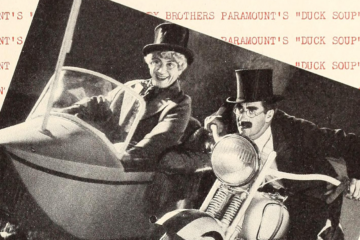
- Not the best poster in the world for this one (why is Tracy sneezing? who the hell pasted a top hat on Harlow and why?!), but I do like the illustration. Every time Harlow starts beating the shit out of Tracy in the film, I smiled a little bit on the inside.


11 Comments
brianpaige · June 23, 2013 at 4:12 pm
Surprising to see this only gets an Indifferent rating. Most critics probably prefer it to another Tracy flick, The Half Naked Truth (1932). It’s ironic that this movie is considered nothing but a Harlow outing since the mechanics of it are completely and utterly a Lee Tracy vehicle. Seriously, you could put any chick in Hollywood in the Harlow part (Lupe Velez was in Half Naked). It’s Tracy that makes the film work.
As far as this film goes, it runs a bit long. It would have been better at roughly 78 minutes (again, Half Naked Truth was about that length). The Arizona scenes drag it down a bit, or maybe the Pat O’Brien subplot….just SOMETHING drags in this film and it needed to be about 15 minutes shorter.
Danny · June 23, 2013 at 7:38 pm
You listed out most of the problems I had with the movie, and you’re surprised by the rating? I agree that there’s some really good bits here, but I think I mentioned it above: Lee Tracy ain’t my cup of tea. This movie’s length too (they should have gone to Arizona sooner) doesn’t help much either. I still like what it tries to do, and think Harlow’s great, though.
Andrew · August 22, 2013 at 8:42 pm
Here’s the thing about Lee Tracy.
I’ve been watching a lot of his stuff recently and personally I think he’s terrific. Then I watched Bombshell and I can see where your problem is, because even I as a fan found him to be too obnoxious- he’s doing his usual shtik, but at a louder volume and with very little that’s actually funny to say. In his other movies when he has good writing and direction behind him, his manic energy becomes a lot of fun to watch and he comes across as more of a scamp rather than a boor.
And of course if you wanna talk about Pre-Code characters, his reporters, lawyers, press agents and politicians were usually relentless self-preservationists willing to ruin other people’s lives for their own purposes (as in Bombshell) and usually got away with it- certainly something Hays and Breen would have put a stop to, so for that reason he’s just as important to Pre-Code as the much more celebrated Warren William.
Try watching “Blessed Event” or “Clear All Wires.” Sure, he can still be a rat, but at his best, he’s an awfully fun rat.
Danny · August 23, 2013 at 2:16 pm
I will admit I just watched him in Dinner at Eight and he was excellent with what was probably the most emotionally honest male performance in the ensemble, and I like a lot of what you’re saying. I saw Blessed Event and didn’t care for it, but I’ll give it another shot when it’s time to write a review.
Andrew · August 23, 2013 at 5:23 pm
Funny, I just watched “Dinner At Eight” last night myself- I agree Tracy’s quite good in that, but a friend of mine commented that he thought he was just hammy standing next to Barrymore, so like they say, there’s no accounting for taste- at least not when it’s someone else’s.
I still love “Blessed Event”, so I hope a second viewing changes your mind- otherwise I guess we’ll just have to agree to disagree.
JennyG · August 14, 2014 at 8:35 am
Another Harlow vehicle, The Girl from Missouri, is currently streaming on Warner Instant, and I recommend it for a viewing and a review. Penned by Anita Loos and co-starring the hilarious Patsy Kelly, Girl, like Bombshell, gives us Harlow and Franchot Tone but as the romantic leads. They’ve got great chemistry, and Girl as a whole is a fast-paced good time.
Danny · August 15, 2014 at 9:35 am
That one is very much on my To-Do list and just keeps getting pushed back. Hopefully in the next few months!
ladylavinia1932 · July 16, 2015 at 3:04 am
I don’t think Lee Tracy’s character is meant to be nice. Nor do I believe that Lola and Space are meant to live “happily ever after”. Is that what you were expecting?
ladylavinia1932 · July 16, 2015 at 3:06 am
I forgot to add that Lola’s attempt to leave Hollywood and have a “normal” life (as if such a thing actually exists) was at best, an illusion on her part. For better or worse, I hope that she had wised up to that fact by the end.
misscast · January 9, 2017 at 7:26 am
Nice post, I’m watching it now and he says, “Queer place, California – insane people running around the desert and such!”, which makes it even funnier.
Lee Jones · July 7, 2019 at 9:54 am
“Bombshell” has a running time of 96 minutes. And I’ve seen it myself. I don’t know. I guess I didn’t find the pacing slow. And I have to say this about Lola Burns. If she really wanted a “normal life”, she would have given up acting a long time ago. I don’t think she really wanted to. I think she wanted more control over her life and career. The movie ended with her realization of that. Whether she tried to take control is another matter.
Comments are closed.